What Science Still Can't Explain About Where We Came From
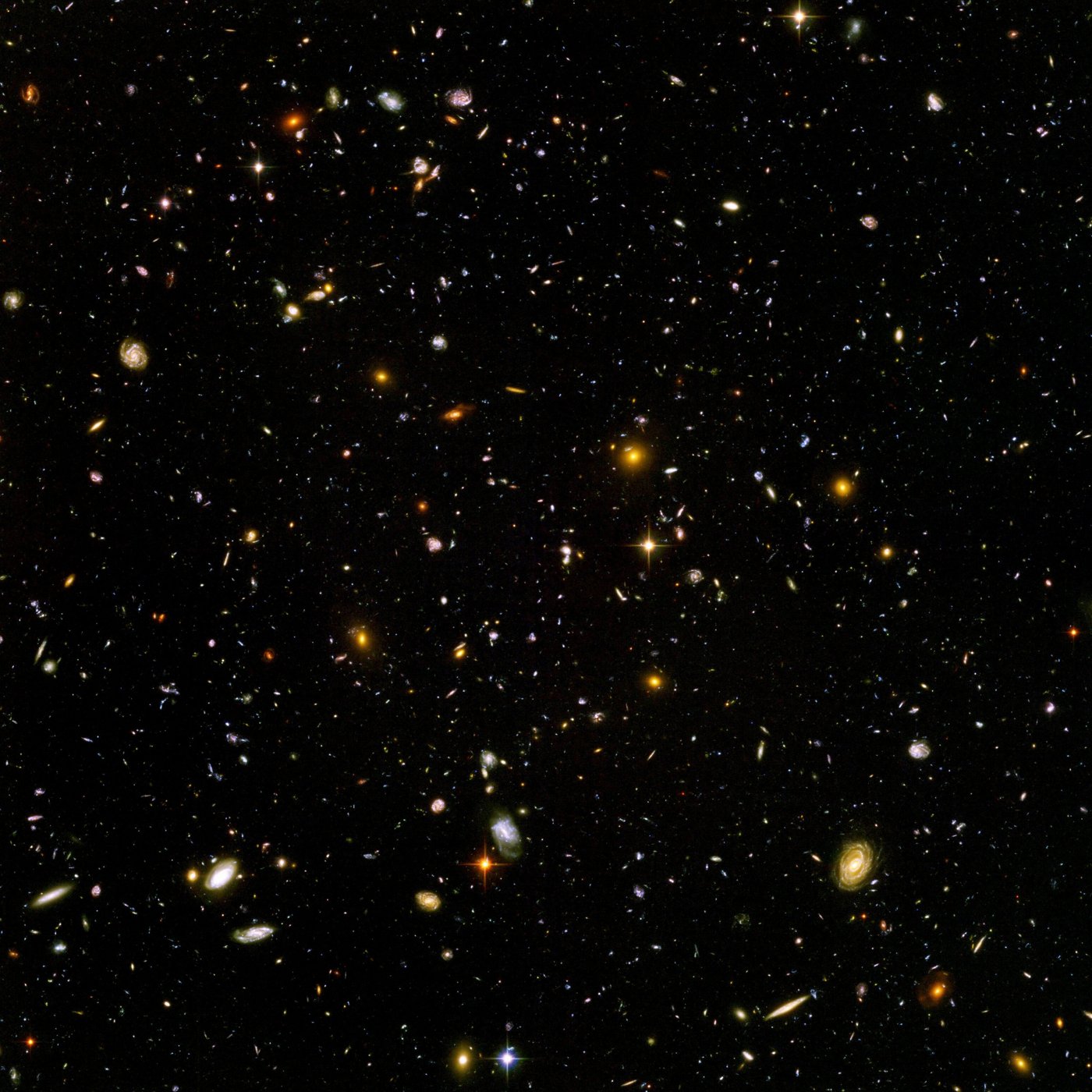
Hubble Ultra Deep Field. Credit: NASA, ESA — public domain, via Wikimedia Commons.

A short video making the case that evolution is “an unproven theory” got me thinking about what’s actually true here, versus what gets repeated as though it’s settled.
So I went and checked. Not what one side or the other says about itself, but what the actual research says. And I want to be upfront about terms before I say anything else, because this gets muddled fast: “evolution” usually means common descent and change in existing life over time. That’s a different, much better-evidenced question than where the universe came from, or how the first life began. I’m not going to blur those together to make a stronger-sounding case. Here’s what each one actually looks like.
What the evidence is actually strong on
Common descent, existing life sharing ancestry and changing over time, has real, converging evidence behind it: the fossil record, DNA comparisons across species, shared anatomical structures. That’s not a weak claim, and I’m not going to pretend otherwise to make a better argument. Multiple independent fields point the same direction.1
What isn’t settled
Two questions sit underneath and before that whole conversation: what set the universe in motion, and how the first living cell arose from non-living chemistry. Both are still genuinely open in the actual scientific literature, not just in the sense of “details being worked out,” but in the sense that no complete, established answer exists yet.
Where did the universe come from?
The standard Big Bang model describes the universe’s expansion from an early hot, dense state extremely well. What it doesn’t do is explain what came before that, or whether “before” and “caused” even apply. General relativity’s own equations predict infinite density at the very beginning, which physicists read as the theory hitting the edge of where it works, not as a measured fact about what actually happened. The honest answer from people working the problem directly: it would take a working theory of quantum gravity to even approach this, and we don’t have one yet.2
How did life begin?
This is the sharper one. Not “how did life change once it existed,” but how you get from non-living chemistry to a first cell that could replicate and pass on information. A 2025 review in a leading biology journal puts it plainly: “the necessary conditions for these processes often appear incompatible and are seldom found together in a single environment.”3 A separate review calls the deepest part of it, how genetic inheritance and biochemical information first connected, “perhaps the largest open question in the emergence of life.”4 Real research has made progress on individual pieces. Nobody has connected them into a demonstrated, complete pathway.
Where this leads, and where it doesn’t
I’m not going to tell you a scientific paper has proven God exists. That’s not what these findings say, and I’d rather stop short of a claim than stretch one. An open scientific question isn’t evidence against a natural explanation either; “we don’t have a complete answer yet” is the normal state of hard research, not proof that no natural answer is possible. Someone could read the exact same gap and conclude it’s a research program still in progress, nothing more. That’s a fair reading, and I’m not going to pretend it isn’t.
Here’s why I read it differently. A living cell doesn’t just need the right chemicals in the right place. It needs a genetic code, a molecular mapping where a sequence in DNA gets copied, read, and translated into a working protein by dedicated machinery built for exactly that job. Critics of the point I’m about to make would say that’s a chemical process, not a language, and that comparing it to meaning and reading smuggles in a conclusion biology never claimed. That’s a fair objection, and here’s my honest answer to it: I look at a system that carries and executes instructions, and I find it easier to believe a mind stands behind that than to believe it arranged itself. That’s not something the papers say. It’s the lens I bring to what they leave open, one further step than the research itself takes, and I want to be clear that’s what it is.
Worth being honest about two more things before I get there. First, science has closed plenty of gaps like this one before without needing a designer, so “still open” is not by itself a reason to expect this one stays open. I don’t think it does close the same way, but that’s my read, not a rule the history of science hands me. Second, an unsolved question doesn’t pick out my faith specifically over any other explanation somebody might place in the same gap. What decides that for me isn’t the gap. It’s Scripture.
Into that real, acknowledged gap, here’s what I bring:
In the beginning God created the heavens and the earth. (Genesis 1:1, NKJV)
For since the creation of the world His invisible attributes are clearly seen, being understood by the things that are made, even His eternal power and Godhead, so that they are without excuse. (Romans 1:20, NKJV)
That’s a theological conclusion, not a scientific one, and I’d rather say so plainly than let it borrow authority it hasn’t earned. What I didn’t need to do was stretch a single fact to get there. The gap is real. Placing a Creator in it is what I believe. Those are two different kinds of claim, and keeping them that way is the whole point of writing this down.
A shorter, physics-scoped version of the science half of this, with the same sources, is up on solvetheuniverse.com.
National Academies of Sciences, “Evidence Supporting Biological Evolution,” Science and Creationism, 2nd edition. ↩︎
MIT Department of Physics, “It all started with a Big Bang — the quest to unravel the mystery behind the birth of the universe.” ↩︎
Ricard Solé, Christopher Kempes, Susan Stepney, “Origins of life: the possible and the actual,” Philosophical Transactions of the Royal Society B, 380(1936): 20240281, October 2025. DOI: 10.1098/rstb.2024.0281. ↩︎
Christopher J. Butch, Markus Meringer, Jean-Sebastien Gagnon, H. James Cleaves II, “Open questions in understanding life’s origins,” Communications Chemistry, 4, Article 11, February 2021. ↩︎